Dr. Cone Sullivan,
Original Message:
Sent: 03-05-2026 10:42
From: Jensyn Cone Sullivan
Subject: Ask Me Anything: Transfusion Medicine/Cellular Therapies Edition
(2) What was my most impactful decision during training? Ooof. That's a hard call. After choosing a specialty, I think choice of a fellowship was particularly impactful, yes, due to the quality of education, but more for the cohort of mentors, sponsors and friends I connected with there. I came to medicine with little research experience in undergrad and med school. Watching my mentors do research in residency, fellowship, and as a junior attending was an education in itself. From them, I learned that friendships and connections (the dreaded 'networking') are crucial in research, and that showing up, being kind, and responsibly following through on work is half the battle in doing interesting research.
------------------------------
Jensyn Cone Sullivan Laboratory Medical Director (Assistant Director)
Ann Arbor MI
------------------------------
Original Message:
Sent: 03-05-2026 10:34
From: Jensyn Cone Sullivan
Subject: Ask Me Anything: Transfusion Medicine/Cellular Therapies Edition
Great questions, Breann.
(1) Two topics that never came up formally during my training were scientific and motivational (e.g., boss/department/hospital, I need money to do XYZ) communication and project management. Both are crucial to work success.
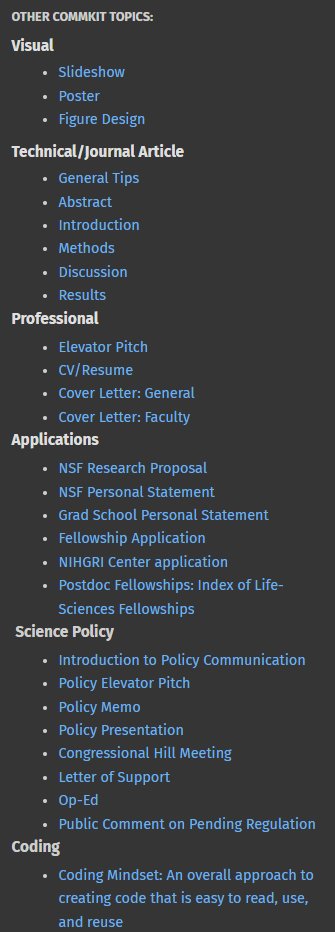
Re communication, when you're working in the weeds, it's easy make the assumption that others know what's old-hat knowledge to you, but they often don't. Often, when asking for money or presenting at a conference, a clear, simple narrative with more sparse visuals is far better and more effective than dense and detailed. Re communication, one of the best resources I've encountered is this MIT/Broad Research Communications Lab toolkit with specific advice for many different types of comms--presentations, papers, op-ed, congressional hill meetings (https://mitcommlab.mit.edu/broad/commkit/slideshow/; see topics covered in inline screenshot). I use it for pretty much every paper and presentation.
------------------------------
Jensyn Cone Sullivan Laboratory Medical Director (Assistant Director)
Ann Arbor MI
Original Message:
Sent: 03-04-2026 10:27
From: Breann Zeches
Subject: Ask Me Anything: Transfusion Medicine/Cellular Therapies Edition
Dr. Cone Sullivan,
Thank you so much for taking the time to answer our questions. I had a few questions I would like to ask:
1) Which skills do you think are most under-emphasized in pathology training, and how can trainees intentionally build them?
2) What is one decision you made during training that had the greatest long-term impact on your career?
Breann
------------------------------
Breann Zeches, MD
Neuropathology Fellow
Resident Council
Nashville, TN
Original Message:
Sent: 03-03-2026 10:39
From: Jensyn Cone Sullivan
Subject: Ask Me Anything: Transfusion Medicine/Cellular Therapies Edition
(3) Re day-to-day life, per year, I do about:
- 10 weeks apheresis clinic and apheresis blood bank call (see ~8 patients a day, manage treatment course, write notes, see new consults, cover off-hours pages for blood bank and apheresis emergencies. I get maybe 1-2 major overnight calls per week, but manage the vast majority of events, even new apheresis patients, remotely.)
- 10 weeks blood bank (signing out transfusion reactions, finding appropriate blood for hard-to-match patients, supporting platelet refractory, massive hemorrhage and hemolytic disease of the fetus and new born patients.)
- In between, I love research and regulatory work. Today is a non service day, and I'm:
- Editing a figure for a (hopefully this week) paper submission
- Editing a white paper on Transfusion Medicine Fellow Education Remediation (which the program I'm fellowship director of hasn't needed to do recently, but can be a challenge)
- Updating my CV to support an upcoming academic promotion (and raise!)
- Working on Cellular Therapy lab management documentation
- Editing a RBC antibody informational database, for a national, cloud-based transfusion patient history sharing database.
------------------------------
Jensyn Cone Sullivan Laboratory Medical Director (Assistant Director)
Ann Arbor MI
Original Message:
Sent: 03-03-2026 10:26
From: Jensyn Cone Sullivan
Subject: Ask Me Anything: Transfusion Medicine/Cellular Therapies Edition
(2) Re collaborating with teams, I think one of the most valuable 'helps' is developing clinical, professional and friendly relationships with frequent contacts on those teams. Knowing them and, hopefully, developing mutual respect before high pressure decision making often smooths challenges. Being available, kind, knowledgeable, and helpful are almost easy out answers, but make all the difference in the world, I think.
------------------------------
Jensyn Cone Sullivan Laboratory Medical Director (Assistant Director)
Ann Arbor MI
Original Message:
Sent: 03-03-2026 10:21
From: Jensyn Cone Sullivan
Subject: Ask Me Anything: Transfusion Medicine/Cellular Therapies Edition
Hey Lauren,
Thanks so much for having me!
(1) I began pathology residency AP-only, but found that topically, the process driven thinking (if I tweak this, then that will happen; I can optimize this assay design by trying x, y, z) was a better fit for my brain than visual pattern analysis. I was drawn to Transfusion because it encompasses so many diverse topics--laboratory management, pre-transfusion testing, transfusion best practice, apheresis clinical patient care, and my current passion, and a rapidly expanding, very powerful field, cell and gene therapy.
In Transfusion, every day can look different--this past month, I've participated in a respiratory arrest code, gathered data supporting the existence of transfusion related alpha gal syndrome (that tick-bite meat allergy entity--hopefully more data to come soon!), submitted grants to support work tying blood types to GVHD susceptibility, with Lauren, and worked through problems like, what happens if a patient has a clinically significant antibody targeting the allogeneic hematopoietic stem cell transplant their getting today? Never a dull moment, which I unabashedly love.
------------------------------
Jensyn Cone Sullivan Laboratory Medical Director (Assistant Director)
Ann Arbor MI